Abstract
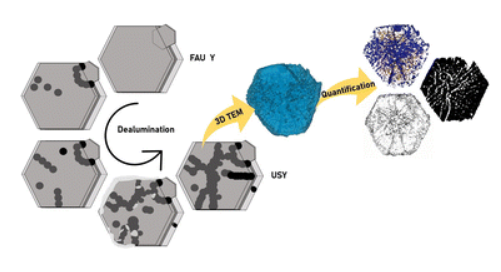
Faujasite Y zeolites (FAU-Y) represent one of the most important categories of heterogeneous catalysts. They are historically known for their crucial role in the refining industry, and they have growing potential for upgrading bio-based products today. However, the thermal stability, acidity, and molecular transport properties of the synthesized zeolite are not ideal for the intended process conditions, activity, selectivity and catalyst deactivation. Consequently, post-synthesis physical–chemical treatments, such as dealuminating treatments, are usually employed to design a more efficient material that combines stronger acidity, better stability, and hierarchical porosity. This material is referred to as Ultrastable Y (USY) zeolite. Nevertheless, the precise mechanisms of mesopore network formation and its relationship with the crystal structure and morphology remain poorly understood. Our research investigates the evolution of the porous system induced by the dealumination in FAU-Y zeolites. Here, we propose a classification, quantification, morphological description and formation scheme of the mesopores with an unprecedented level of detail, that is based on electron tomography data from the main steps of the dealumination process. Four main groups of pores are identified: (1) closed, isolated mesopores with more spherical shapes and diameters of 7–8 nm; (2) open intracrystalline channeling mesopores that often run along crystallographic orientations, vary in diameter, and whose morphology recall a mechanism of isolated mesopore coalescence; (3) intercrystalline mesopores with irregular shapes detected at the boundaries of twinned crystals, and (4) surface roughness. We finally observe that the localization and development of mesopores are associated with structural defects, such as stacking faults and twinning. These results allow us to consider a nucleation/diffusion mechanism for the mesoporous network within zeolite Y during dealumination and provide guidelines for identifying new pathways to optimize hierarchical zeolites.
Author(s): Consolaro, VG (Consolaro, Valentina Girelli); Rouchon, V (Rouchon, Virgile); Baaziz, W (Baaziz, Walid); Hammoumi, A (Hammoumi, Adam); Ferte, T (Ferte, Tom); Pirngruber, G (Pirngruber, Gerhard); Moreaud, M (Moreaud, Maxime); Ersen, O (Ersen, Ovidiu)
https://doi.org/10.1039/d5nr01457c
NANOSCALE
Early Access Date: SEP 2025 Published Date: 2025 SEP 11
Accession Number: WOS:001573578300001
PubMed ID: 40965178
ISSN: 2040-3364
eISSN: 2040-3372