Abstract
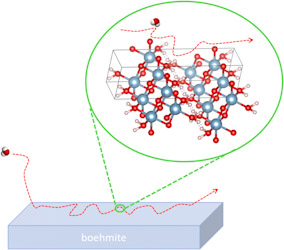
The 1H NMR relaxation dispersion (NMRD) profile of water in boehmite systems has been studied in detail. The NMRD profiles, recorded for weakly hydrated particles up to diluted suspensions, exhibit the very same shape, and a mastercurve can be obtained. 1H NMR relaxation rate 𝑅1 strongly varies with the field indicating a slow dynamics at the surface of the boehmite particles. In addition, a bump around 0.7 MHz is observed. This characteristic feature may arise either from an interaction with a paramagnetic species or from an interaction with a quadrupolar nucleus. In the literature, this bump for aluminum hydroxide compounds has been independently attributed to one or the other interaction and a definitive answer must be provided. By decreasing the temperature, the bump increases, whereas the electron spin spectroscopy (ESR) detects a weak amount of paramagnetic species. 27Al solid-state NMR spectrum is characterized a peak with a central transition at 9.7 ppm and quadrupolar constant equal to 2.7 MHz. The atomic force microscopy (AFM) image of individual boehmite particle evidences that the number of aluminum at the surface is high enough to be detected by solid-state NMR. Hence, the values of the 27Al quadrupolar parameters obtained by solid-state NMR can be directly used for the calculation of the quadrupolar relaxation enhancement..
Alice Ducroix, Zlanseu Ruth Tan, Thierry Allard, Thibaud Chevalier, Guillaume Mériguet, Sandrine Leclerc, Serge Durand-Vidal, Flavien Guenneau, Natalie Malikova, Vincent Sarou-Kanian, Anne-Laure Rollet, Pierre Levitz
https://doi.org/10.1002/mrc.70134
Magnetic Resonance in Chemistry
2026; 0:1–11