Abstract
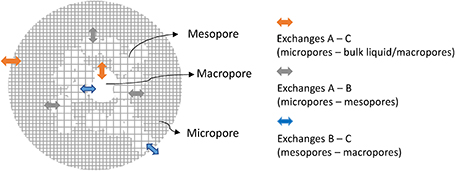
Hierarchical zeolites presenting different pore domains have the potential to reduce problems associated with low diffusion in zeolites, thus holding great promise in a wide range of application fields. Nevertheless, efficient transfer between the different porous networks is required for the mesopores (2–50 nm) and macropores (>50 nm) to be effective in promoting the transit of molecules towards the micropores (<2 nm). In this work, the connectivity between the various pore domains in a class of hierarchical zeolites – denominated as nanoparticle aggregates – is investigated through 2D exchange spectroscopy (EXSY) 1H nuclear magnetic resonance (NMR) using paraxylene as a probe molecule. This approach allows to track whether the probe molecule visits distinct pore environments over time, providing unique insight into pore connectivity. The analysis of scanning curves through N2 adsorption/desorption cycles completes the characterization of pore connectivity. Furthermore, electron microscopy and tomography are used as visual techniques to confirm the arrangement of the mesoporous and macroporous networks generated by the nanoparticle aggregates.
Author(s): Medeiros-Costa, IC (Medeiros-Costa, Izabel C.); Wisser, D (Wisser, Dorothea); Catita, L (Catita, Leonor); Lesage, A (Lesage, Anne); Lefebvre, V (Lefebvre, Veronique); Gay, AS (Gay, Anne-Sophie); Rouchon, V (Rouchon, Virgile); Laroche, C (Laroche, Catherine); Pérez-Pellitero, J (Perez-Pellitero, Javier); Coasne, B (Coasne, Benoit)
https://doi.org/10.1016/j.matchemphys.2024.128969
MATERIALS CHEMISTRY AND PHYSICS
Volume: 315 Article Number: 128969 DOI: 10.1016/j.matchemphys.2024.128969 Early Access Date: FEB 2024 Published Date: 2024 MAR 1
Accession Number: WOS:001177393700001
ISSN: 0254-0584
eISSN: 1879-3312